
How to Get from Haneda Airport to Ueno? A Thorough Comparison of Transport Options and Our Recommended Route
8 min read
Ueno is home to countless tourist attractions.
Besides Ueno Zoological Gardens and Ameyoko, the area is also famous for its many art museums and museums.
When heading from Haneda Airport to Ueno Park, it’s hard to decide which mode of transport to use.
This article thoroughly compares transport options from Haneda Airport to Ueno, covering fares, travel time, and pros and cons. We’ve also included our recommended route, so be sure to use this as a reference.
5 Transport Options from Haneda Airport to Ueno
Here we explain five ways to get from Haneda Airport to Ueno.
-
Train/Monorail
-
Limousine Bus
-
Car/Motorcycle
-
Taxi
-
NearMe
Each option has its own pros and cons, so choose wisely based on your needs.
1. Train/Monorail
The classic mode of transport is the train. The fare is ¥500 (Keikyu Line: ¥292, JR: ¥208), and the journey takes roughly 40 to 55 minutes including transfers.
| Route | Fare (IC card) | Time |
|---|---|---|
| Keikyu Line + JR Line (Haneda Airport Terminal 1・2 Station → Ueno Station) | ¥500 | Approx. 40–55 min *including transfers |
The route is “Haneda Airport Terminal 1・2” (Keikyu Line) → “Shinagawa” (JR Yamanote Line or JR Tokaido Main Line [Ueno-Tokyo Line]) → “Ueno.”
If the Keikyu Line train is bound for “Zushi/Hayama” (toward Yokohama), you’ll need to transfer to a Shinagawa-bound train at “Keikyu Kamata.”
The ticket gates for the Keikyu Line’s “Haneda Airport Terminal 1・2” Station are on basement level 2 of Haneda Airport. The ticket gate for the “Haneda Airport Terminal 3” Station (upbound platform) is on the 2nd floor above ground, the same level as the arrivals lobby.
【Pros】
- The cheapest option available
- No traffic congestion, so arrival times are predictable
- Frequent service
- Since “Haneda Airport Terminal 1・2” is a starting station, waiting for the next (later) train can get you a seat (as far as Shinagawa or Keikyu Kamata)
【Cons】
- Can get crowded at certain times (morning and evening rush hours, etc.)
- Hard to find space for large luggage like suitcases
- Transferring is a hassle
Monorail
While it doesn’t go directly to Ueno, you can also take the monorail partway.
The fare is ¥670 (Tokyo Monorail: ¥492, JR: ¥178), and the journey takes roughly 35 to 45 minutes including transfers.
| Route | Fare (IC card) | Time |
|---|---|---|
| Tokyo Monorail + JR Line (Haneda Airport Terminal 2 Station → Hamamatsucho Station → Ueno Station) | ¥670 | Approx. 35–50 min *including transfers |
The route is “Haneda Airport Terminal 2” (Tokyo Monorail) → “Hamamatsucho” (JR Yamanote Line or JR Keihin-Tohoku/Negishi Line) → “Ueno.” The monorail ride takes 14 minutes on the Airport Rapid service or 21 minutes on the local service. The JR ride takes 15 minutes.
Compared to the Keikyu Line, it’s less crowded and also has luggage storage space, so you can travel with peace of mind even with large bags. The fare is a bit higher than the train, but you can enjoy a leisurely, unusual view of the waterfront scenery.
That said, since it runs while swaying at height, people with a fear of heights may struggle to enjoy the scenery and might want to avoid this option.
The ticket gates for “Haneda Airport Terminal 1” Station and “Haneda Airport Terminal 2” Station are on basement level 1. The ticket gate for “Haneda Airport Terminal 3” Station is on the 2nd floor above ground, the same level as the arrivals lobby.
Unlike the Keikyu Line, the monorail has separate stations for “Haneda Airport Terminal 1” and “Haneda Airport Terminal 2.”
【Pros】
- Relatively uncrowded
- Has luggage storage space
- You can enjoy the unusual sight of waterfront scenery
- Since “Haneda Airport Terminal 2” is a starting station, waiting for the next (later) train can get you a seat (all the way to the terminus, Hamamatsucho)
【Cons】
- Fare is a bit higher than the train
- Runs at height, so there’s a bit of swaying
- People with a fear of heights may struggle to enjoy the scenery
3. Limousine Bus
There’s no direct limousine bus to Ueno, but you can take one to the nearby “Asakusa View Hotel.”
*There used to also be a bus to “Akihabara,” but as of March 2023 it is suspended.
Additionally, the bus to Asakusa View Hotel only runs during the daytime and is suspended at night. As such, the first bus departs at 11:45 (arriving 13:05), and the last bus departs at 18:45 (arriving 20:05).
The bus fare is ¥1,100, and the journey takes roughly 1 hour 5 minutes to 1 hour 20 minutes. From Asakusa to Ueno by train, the fare is ¥335 (Tsukuba Express: ¥168, JR: ¥167), and the journey takes roughly 20 minutes including transfers.
The route is “Haneda Airport Terminal 3” (Tokyo Airport Transport Limousine Bus) → “Asakusa View Hotel” → (1-minute walk) → “Asakusa (TX)” (Tsukuba Express) → “Minami-Senju” (JR Joban Line [Ueno-Tokyo Line]) → “Ueno.”
The bus boarding points are as follows.
- Terminal 1: Boarding point 5
- Terminal 2: Boarding point 6
- Terminal 3: Boarding point 5
Tickets can be purchased for a specific time slot at the ticket vending machines or the bus ticket counter. In addition to cash, credit card payment is also available.
If using a coupon ticket or a transportation IC card, you’ll need to get a “time-specified ticket” from the staff at the boarding point before boarding.
【Pros】
- Reserved seating means you’re guaranteed a seat
- Large luggage can be stored in the under-floor trunk compartment
【Cons】
- Fare is higher compared to the train or monorail
- You won’t get a seat if the bus is full
4. Car/Motorcycle
You can also drive yourself without using public transport, or have a family member or friend give you a ride.
The expressway route is “Kuko Chuo” (Metropolitan Expressway Wangan Line) → “Oi JCT” (Metropolitan Expressway Route 1 Haneda Line) → “Hamazakibashi JCT” (Metropolitan Expressway Inner Circular Route) → “Edobashi JCT” (Metropolitan Expressway Route 1 Ueno Line) → “Ueno.”
The expressway toll is ¥1,950 at the regular rate, ¥790 with ETC, and ¥630 with the late-night discount. The distance is 19.3 km, and the estimated travel time is 19 minutes. For reference, without using the expressway, the travel time is roughly 40 minutes.
One thing to note is that stopping or parking in front of each terminal at Haneda Airport is prohibited, so you can’t board directly from the arrivals lobby. Even if someone is picking you up, you’ll need to go to the parking area to get in the car.
The parking lots are P1/P2 for Terminal 1, P3/P4 for Terminal 2, and P5 for Terminal 3. They can fill up on holidays, so if you’re short on time, public transport may be the better choice.
【Pros】
- You can go at your own pace
- No need to worry about other passengers
- You’re free to make stops along the way
【Cons】
- Easy to get lost if you’re not familiar with the roads
- You may get caught in traffic
- If the parking lot is full, you’ll have to wait in line
5. Taxi
The easiest mode of transport is a taxi. You can hail one directly from the taxi stand, but if you book in advance, you can use the “Haneda Airport Flat-Rate Taxi.”
The fare to Taito Ward, Tokyo, where Ueno is located, is ¥8,400 (¥9,900 during late-night/early-morning hours, 22:00–5:00). In addition to the fare, expressway tolls are added on top.
For reference, a fare simulation using the JapanTaxi fare search (https://japantaxi.jp/charge-search/) shows a fare of about ¥11,100 (¥13,300 during late-night/early-morning hours, 22:00–5:00), with a travel time of 26 minutes (23.5 km).
【Pros】
- Door-to-door, so no walking required
- You can put your luggage in the trunk
- No need to worry about other passengers
- Flexible timing
【Cons】
- The most expensive option
- You may get caught in traffic
- Not well suited for large groups
6. NearMe
In recent years, NearMe has been gaining popularity as a transport option. It’s a new service that lets you use larger vehicles, like the Hiace or Alphard, as a shared-ride taxi.
The simulated fare from Haneda Airport to Ueno is from ¥2,980 per person, with a travel time of 22 to 38 minutes. Unlike a taxi, there’s no expressway toll to pay. AI-based matching determines the optimal route.
The first suitcase is free, but a fee of ¥1,000 per bag is added for each additional suitcase beyond the first.
【Pros】
- Get door-to-door service for less than a third of the price of a taxi
- Spacious interior
- You can check in your luggage
- Charter option available (can transport large groups)
【Cons】
- Limited service area
*Taito Ward, Tokyo, where Ueno is located, is within the service area, so there’s no issue.
Our Recommended Way to Get from Haneda Airport to Ueno: “NearMe”
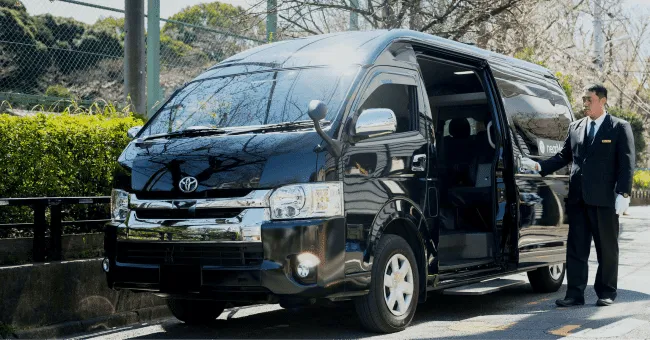
Among the transport options from Haneda Airport to Ueno, NearMe is the one we especially recommend.
There’s no other service that lets you enjoy the comfort of a taxi at less than a third of the price.
If you have large luggage, the limousine bus can be an appealing, affordable option, but there’s no direct route from Haneda Airport to Ueno, and connecting by train from Asakusa takes extra time and effort.
Besides large luggage, if you’re traveling with small children or elderly family members, door-to-door transport is extremely comfortable.
If you’re after the cheapest fare, the train is your best bet, but if you want a comfortable ride, we recommend NearMe for its excellent cost performance.
Summary
We’ve introduced and thoroughly compared six transport options from Haneda Airport to Ueno.
“Train,” “Monorail,” “Limousine Bus,” “Car/Motorcycle,” “Taxi,” and “NearMe” each have their own pros and cons.
When choosing a mode of transport, fare and comfort are the key considerations, and NearMe offers the best balance and cost performance of them all.
When traveling from Haneda Airport to Ueno, please consider it as one of your options.
Related Articles
![Comparing Taxi-Hailing Apps in Saitama [2026]: How to Choose the Right One in Omiya, Urawa, and Kawaguchi](/_astro/22856472_s.CtsmBGn8_DUDfv.webp) Haneda Airport
Haneda AirportComparing Taxi-Hailing Apps in Saitama [2026]: How to Choose the Right One in Omiya, Urawa, and Kawaguchi
Not sure which app to choose when you want to catch a taxi in Saitama? This article compares the coverage areas and fares of major taxi apps like GO, S.RIDE, and DiDi, and explains in detail how to choose by area for Omiya, Urawa, and Kawaguchi. We'll also introduce NearMe for airport transfers and long-distance trips.
![How to Master Kanagawa Taxis: Smart Usage by Area and Destination [2026]](/_astro/34641748_s.BEOJdjik_Zh5tyA.webp) Haneda Airport
Haneda AirportHow to Master Kanagawa Taxis: Smart Usage by Area and Destination [2026]
Struggling to catch a taxi in Yokohama or Kawasaki? Not sure how to get around Hakone or Kamakura? Want a guaranteed early-morning ride to Haneda Airport? This article breaks down the latest 2026 fare structure and offers a complete strategy tailored to key spots like Yokohama Station, Shin-Yokohama Station, and Haneda Airport.
![Taxis in Chiba: Smart Ways to Get Around by Area and Destination [2026]](/_astro/26296344_s.BzFkm6Ou_1Fu3m.webp) Haneda Airport
Haneda AirportTaxis in Chiba: Smart Ways to Get Around by Area and Destination [2026]
Struggling with "I can't catch a taxi in Chiba" or "I can't get a reservation"? Drawing on the latest 2026 ride-hailing landscape, this guide walks through the smartest ways to get a taxi from urban centers like Chiba City, Kashiwa, and Funabashi to major destinations such as Narita Airport, Tokyo Disney Resort®, and Makuhari Messe, tailored to your destination and time of day.