
The Narita Express (N'EX): Everything You Need to Know About Riding It and Fares
13 min read
Many people heading to Narita Airport use the Narita Express because it’s easy to reach from major stations in central Tokyo. But if you don’t ride it often, there’s a lot you might not know—like how to board or how much it costs.
This article covers the following:
- Basic information about the Narita Express
- Pros and cons of the Narita Express
- Things to watch out for when boarding
- Other ways to get to the airport
We hope you find it useful.
What Is the Narita Express (N’EX)?
First, let’s go over the following aspects of the Narita Express (N’EX):
- What the Narita Express is
- Service area
- Train information
- Fares
- How to buy tickets
- Travel time to Narita Airport
Since this is the basic information, let’s make sure to check it thoroughly.
What Is the Narita Express?
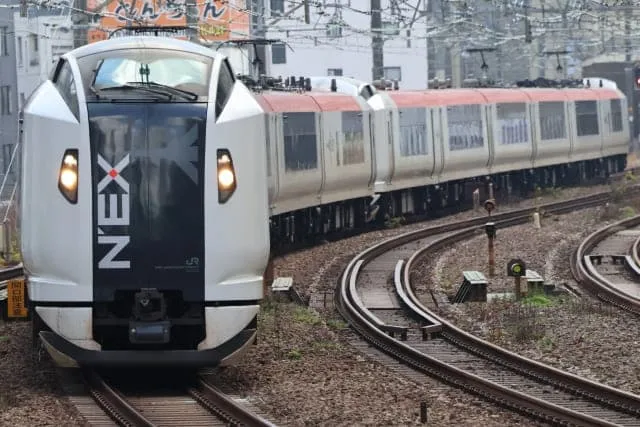
The Narita Express is a train that directly connects Narita Airport with major stations including Tokyo, Shinagawa, Shibuya, Shinjuku, Ikebukuro, Yokohama, and Omiya. It runs from as early as 5 a.m. to as late as 11 p.m.
Since it’s a train designed for access to an international airport, it’s often abbreviated as N’EX (pronounced “Nex”) from its English name, with international passengers in mind.
Every seat comes with a large table and an outlet for laptop use, and there’s 25cm of luggage space at your feet.
The spacious, well-equipped interior that lets you travel comfortably is one of its major appeals.
Service Area
 Source: Narita Express official website
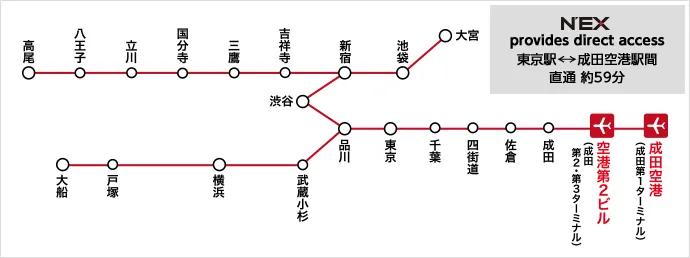
The service area covers 22 stations: Tokyo, Shinagawa, Shibuya, Shinjuku, Ikebukuro, Omiya, Musashi-Kosugi, Yokohama, Kichijoji, Mitaka, Kokubunji, Tachikawa, Hachioji, Takao, Totsuka, Ofuna, Chiba, Yotsukaido, Sakura, Narita, Airport Terminal 2, and Narita Airport.
One of its biggest advantages is that you can get there in about an hour with no transfers from major stations like Tokyo and Shinagawa.
That said, keep in mind that it doesn’t stop at every station on every run. That’s because the Narita Express operates on several different routes, so the intermediate stops vary by train. Tokyo Station is the only stop served by every single train, so it’s a good idea to check the timetable in advance before boarding. (Narita Express official timetable)
Train Information
 Source: Narita Express official website
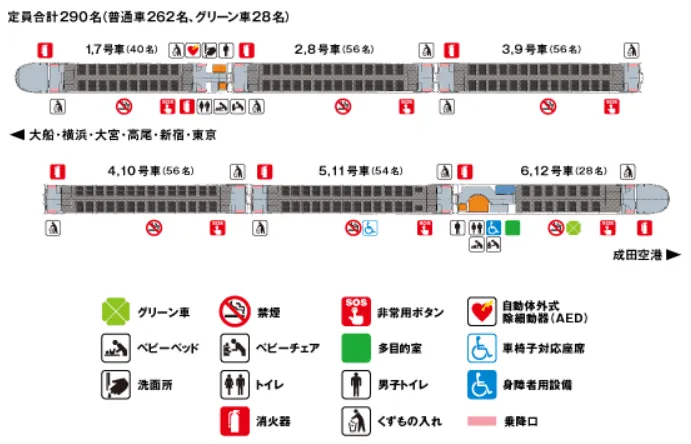
Total capacity is 290 passengers (262 in standard cars, 28 in the Green Car).
The capacity of each car is as follows: Cars 1 and 7 (40 passengers)
Cars 2 and 8 (56 passengers)
Cars 3 and 9 (56 passengers)
Cars 4 and 10 (56 passengers)
Cars 5 and 11 (54 passengers)
Cars 6 and 12 (28 passengers)
On-board facilities:
- Emergency button
- Automated external defibrillator (AED)
- Baby bed
- Baby chair
- Multi-purpose room
- Wheelchair-accessible seating
- Washroom
- Toilet
- Men’s toilet
- Facilities for people with disabilities
- Fire extinguisher
- Trash bin
- Boarding door
Note: All seats are non-smoking.
For the exact location of each facility, please see the Narita Express official website.
Fares
| Narita Express Fare Table (One Way) | Standard Car (Base fare + reserved seat limited express fare) | Green Car (Base fare + reserved seat limited express fare) |
|---|---|---|
| Takao Station ⇔ Airport Terminal 2 / Narita Airport Station | ¥4,700 | ¥6,270 |
| Hachioji Station ⇔ Airport Terminal 2 / Narita Airport Station | ¥4,700 | ¥6,270 |
| Tachikawa Station ⇔ Airport Terminal 2 / Narita Airport Station | ¥4,370 | ¥5,940 |
| Kokubunji Station ⇔ Airport Terminal 2 / Narita Airport Station | ¥4,370 | ¥5,940 |
| Mitaka Station ⇔ Narita Airport Station | ¥4,370 | ¥5,940 |
| Mitaka Station ⇔ Airport Terminal 2 | ¥3,420 | ¥4,990 |
| Kichijoji Station ⇔ Airport Terminal 2 / Narita Airport Station | ¥3,420 | ¥4,990 |
| Ofuna Station ⇔ Airport Terminal 2 / Narita Airport Station | ¥4,700 | ¥6,270 |
| Totsuka Station ⇔ Narita Airport Station | ¥4,700 | ¥6,270 |
| Totsuka Station ⇔ Airport Terminal 2 | ¥4,370 | ¥5,940 |
| Musashi-Kosugi Station ⇔ Airport Terminal 2 / Narita Airport Station | ¥3,420 | ¥4,990 |
| Yokohama Station ⇔ Airport Terminal 2 / Narita Airport Station | ¥4,370 | ¥5,940 |
| Omiya Station ⇔ Airport Terminal 2 / Narita Airport Station | ¥3,910 | ¥5,480 |
| Ikebukuro Station ⇔ Airport Terminal 2 / Narita Airport Station | ¥3,250 | ¥4,820 |
| Shinjuku Station ⇔ Airport Terminal 2 / Narita Airport Station | ¥3,250 | ¥4,820 |
| Shibuya Station ⇔ Airport Terminal 2 / Narita Airport Station | ¥3,250 | ¥4,820 |
| Shinagawa Station ⇔ Airport Terminal 2 / Narita Airport Station | ¥3,250 | ¥4,820 |
| Tokyo Station ⇔ Airport Terminal 2 / Narita Airport Station | ¥3,070 | ¥4,640 |
| Chiba Station ⇔ Airport Terminal 2 / Narita Airport Station | ¥1,970 | ¥3,540 |
| Yotsukaido Station ⇔ Airport Terminal 2 / Narita Airport Station | ¥1,880 | ¥3,450 |
| Sakura Station ⇔ Airport Terminal 2 / Narita Airport Station | ¥1,710 | ¥3,280 |
| Narita Station ⇔ Narita Airport Station | ¥1,530 | ¥3,100 |
| Narita Station ⇔ Airport Terminal 2 | ¥1,490 | ¥3,060 |
How to Buy Tickets
To ride the Narita Express, you need a limited express ticket in addition to a base fare ticket or an IC card such as Suica.
There are three ways to purchase tickets:
- Reserve and purchase through eki-net
- Ticketless service through eki-net
- Reserve and purchase at a ticket counter
Let’s go through each method.
1. Reserve and Purchase Through eki-net
This method lets you access eki-net from a computer or smartphone to reserve and purchase your ticket.
You can apply starting one week before the ticket sales date, which itself is one month before your travel date. Tickets booked through eki-net must be picked up in advance. You can pick up and pay for them at JR East’s reserved-seat ticket machines, Green Windows (Midori-no-madoguchi), and similar locations.
You’ll need the following three things to pick up your ticket:
- The 5-digit reservation number you received when your booking was completed
- The credit card you registered when applying
- Your credit card’s PIN
Also keep in mind that only the person who made the reservation can pick up the ticket.
2. Ticketless Service Through eki-net
eki-net also offers a ticketless service. Using it means you don’t need to go through the process of issuing a physical ticket—you can board with just your phone. It’s a convenient and money-saving option since the eki-net ticketless discount also applies. (You cannot apply from a computer.)
The purchase process is three steps:
- Access the eki-net site from your smartphone or mobile phone and apply through the ticketless application menu.
- Once your application is complete, you’ll receive a purchase confirmation email—save it on your device and bring it with you.
- Board the train (you’ll also need a separate base fare ticket or an IC card such as Suica).
For details, please check the official website.
3. Reserve and Purchase at a Ticket Counter
Tickets go on sale one month before your travel date at Green Windows (Midori-no-madoguchi), View Plaza, reserved-seat ticket machines, and major travel agencies.
Travel Time to Narita Airport
Travel time from major stations in central Tokyo (Tokyo, Shinagawa, Shinjuku, Ikebukuro) to Narita Airport is about one hour.
From any of these major stations in central Tokyo, you can reach Narita Airport without transferring.
Advantages of the Narita Express

The Narita Express has two major advantages:
- Convenience
- Comfort
Both matter a lot when you’re traveling. Let’s look at each in detail.
[Advantage 1] Convenience
The first advantage is the convenience of going directly from major stations to Narita Airport.
You can access the airport directly, without transferring, from major stations in central Tokyo such as Tokyo, Shinagawa, Shinjuku, Ikebukuro, and Hachioji. It also connects major stations throughout the greater Tokyo area, such as Yokohama, not just within Tokyo itself, making it highly convenient. Compared to the Skyliner in particular, you’d need to transfer at Ueno or Nippori Station, and with a highway bus, you’d have to exit through the ticket gates.
Being able to reach Narita Airport from your nearest major station, without having to make a special trip to Ueno or Nippori, is a big advantage.
[Advantage 2] A Comfortable Ride
Another advantage is that the onboard facilities are excellent, letting you spend your time to Narita Airport comfortably.
Every seat has an outlet, along with a large table and a spacious reclining seat. Even in standard seats, there’s plenty of room, and the soft headrest cushions make even a long ride comfortable. The Green Car goes further with full-fledged reclining seats, and since fewer people use it, it offers even more comfort.
This is a great option for anyone who wants to enjoy a relaxing ride to the airport.
Disadvantages of the Narita Express
Here are two downsides of the Narita Express:
- Cost
- Travel time
These are important points to understand before using the service. Let’s look at each in detail.
[Disadvantage 1] Fares Are Somewhat High
The first downside is that the fare is somewhat high.
Compared to the Skyliner, there’s a gap of ¥2,470 including the liner ticket from Ueno or Nippori Station to Narita Airport.
If you want to get to Narita Airport as quickly and cheaply as possible, the Skyliner might be the better choice.
[Disadvantage 2] Travel Time Is Somewhat Long
The second downside is that the travel time between the station and the airport is somewhat long.
Again compared to the Skyliner, the trip from Nippori Station to Airport Terminal 2 takes as little as 36 minutes, while the Narita Express takes at least 54 minutes from its starting point to Narita Airport.
Things to Remember Before Riding the Narita Express
There are three things worth remembering when using the Narita Express.
They are:
- Some stations aren’t served
- You need both a base ticket and a limited express ticket
- All seats are reserved
Let’s go through each in detail below.
[Note 1] Some Stations Aren’t Served
Because the Narita Express runs on a variety of routes depending on the time and departure point, the stations it stops at along the way vary. Tokyo Station is the only stop served by every train, so be sure to check the timetable or a transit app in advance before boarding. See the Narita Express official timetable for details.
[Note 2] You Need Both a Base Ticket and a Limited Express Ticket
Since the Narita Express is a limited express train, you need a limited express ticket in addition to a base fare ticket to ride.
If you already have a base fare ticket, or if you’re using an IC card such as Suica or Pasmo, you only need to purchase the limited express ticket to board.
[Note 3] All Seats Are Reserved
The Narita Express is an all-reserved-seat train—there are no non-reserved seats.
Purchase your ticket in advance and sit in the seat number shown on your limited express ticket. You can choose your seat when you purchase the limited express ticket.
Actually, There Are Many Ways to Get to Narita Airport
So far we’ve covered the Narita Express, but there are actually many other ways to get to Narita Airport.
Here we introduce the following options for getting to Narita Airport:
- NearMe
- Keisei Skyliner
- Limousine bus
- Taxi
NearMe
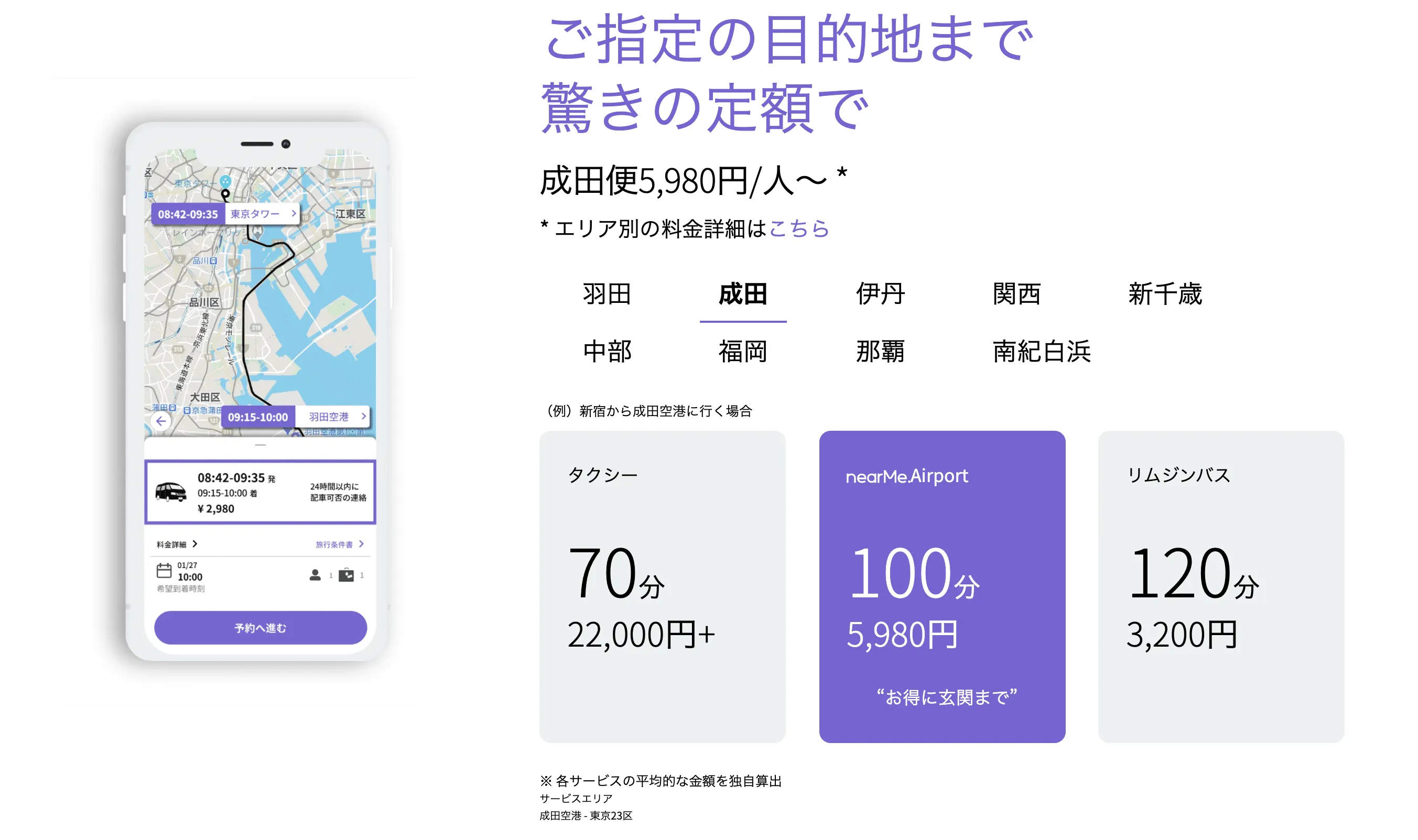
NearMe is a new door-to-door car service we provide that takes you directly to Narita Airport.
Our proprietary AI matches you with the most efficient route, so you can go straight from your home or hotel to Narita Airport, meaning you never have to carry heavy luggage on foot. Vehicles heading to Narita Airport also come equipped with Wi-Fi (not available in some vehicles).
Other features include:
- Smooth travel with online payment
- No extra charges for flight delays
- English support available when booking
As for pricing, it’s a flat rate starting from ¥5,980 per person to Narita Airport.
Previously, bookings had to be made by the day before, but in response to customer requests, you can now book even on the same day, as long as there’s a “shuttle scheduled to run” around your desired time. (Service site)
Keisei Skyliner
This is an airport express train running between Ueno Station and Narita Airport Station.
It runs at the fastest speed of any conventional line, up to 160 km/h, connecting Nippori Station to Airport Terminal 2 Station in as little as 36 minutes (the shortest travel time between Nippori Station and Airport Terminal 2 Station).
Its key feature is a short travel time to Narita Airport.
It reaches Airport Terminal 2 Station from Nippori Station in as little as 36 minutes, and reaches Narita Airport from Ueno in as fast as 44 minutes.
Limousine Bus
Another option is taking a limousine bus to Narita Airport.
Airport Limousine is one well-known operator, and its appeal is the large number of pickup points at stations and hotels.
There’s some risk of delays due to traffic, but you can check the current estimated travel time on their website, which helps put your mind at ease.
The fare varies depending on the distance from Narita Airport, but from central Tokyo it costs around ¥3,200.
It also covers a wide service area, including Tokyo, Kanagawa, Chiba, and Saitama.
Taxi
You can also get to Narita Airport by taxi.
From Tokyo Station to Narita Airport costs about ¥25,000 for a distance of roughly 70km. Taxi fares to Narita Airport from Tokyo’s nine major wards are as follows:
| Fare | Distance/Time | |
|---|---|---|
| Shibuya Ward | Approx. ¥28,020 | 79.3km / 2h 55m |
| Setagaya Ward | Approx. ¥29,380 | 83.4km / 3h 9m |
| Minato Ward | Approx. ¥29,460 | 83.4km / 2h 54m |
| Chiyoda Ward | Approx. ¥25,780 | 72.7km / 2h 38m |
| Chuo Ward | Approx. ¥26,020 | 73.5km / 2h 38m |
| Taito Ward | Approx. ¥25,380 | 71.7km / 1h 3m |
| Sumida Ward | Approx. ¥24,180 | 68.0km / 2h 23m |
| Shinjuku Ward | Approx. ¥27,700 | 78.4km / 2h 53m |
| Bunkyo Ward | Approx. ¥25,860 | 73.1km / 2h 40m |
Comparing the Narita Express with Other Ways to Reach Narita Airport
We’ve introduced a variety of ways to get to Narita Airport, so now let’s compare the Narita Express with the other options.
Here, we’re comparing all options based on a trip from Tokyo Station to Narita Airport.
Comparison Table: Narita Express vs. Other Options
| Narita Express | Keisei Skyliner | NearMe | Limousine Bus | Taxi | |
|---|---|---|---|---|---|
| Travel time from Tokyo Station | About 1 hour | About 50 minutes | About 1 hour 40 minutes | About 1 hour 30 minutes | About 1 hour |
| Fare | ¥3,020 | ¥2,630 | From ¥5,980/person | ¥2,800–¥3,200 | Approx. ¥25,000 |
| Convenience | All-reserved seating, 1–2 departures per hour | All-reserved seating, 3 departures per hour | Reservation required, Wi-Fi equipped, door-to-door pickup | 1 departure every 2 hours |
Pros and Cons of Each Option
Now that you understand how each option compares, let’s summarize the pros and cons.
Fares, convenience, and travel time all differ, and each option has its own strengths and weaknesses, summarized in the table below.
| Narita Express | Keisei Skyliner | NearMe | Limousine Bus | Taxi | |
|---|---|---|---|---|---|
| Pros | ・Comfortable interior ・Easy to access | ・Short travel time ・Low fare | ・Comfortable ride ・Flat-rate door-to-door pickup | ・Accessible from places other than stations | ・Available at any time ・Easy, effortless travel |
| Cons | ・Fare is somewhat high ・Travel time is somewhat long | ・Less convenient depending on the area | ・Fare is somewhat higher than other options | ・Travel time is hard to predict due to traffic | ・Expensive ・Travel time is hard to predict due to traffic |
The options with the strongest advantages tend to come with a higher fare in most cases. You’ll need to choose the service that best fits your needs.
Conclusion
If you’re coming from within Tokyo, the Narita Express is a convenient way to reach Narita Airport.
That said, if you’re departing from somewhere near Nippori or Ueno, or if you want to get there quickly and cheaply, the Skyliner is worth considering.
When you’re traveling with a lot of luggage, such as for a trip, using NearMe is also a great option.
There are many ways to get to Narita Airport, so choosing the one that fits your purpose and needs at the time will make your trip more comfortable.
References:
https://www.jreast.co.jp/nex/charge.html
Related Articles
 Airport Access
【Narita Airport ⇔ Futako-Tamagawa】Complete Bus Guide! Fares and Travel Times Explained
Futako-Tamagawa, located in Setagaya Ward, Tokyo, has become a popular area in recent years thanks to redevelopment across the whole district—commercial facilities, offices, a bus terminal, and more have opened. Green space has also been developed along the Tama River, making it an area families are drawn to for its access to nature.
 Narita Airport
What to Do When Narita Airport Parking Is Crowded: How to Avoid It and Recommended Alternatives
With COVID-19 travel restrictions easing, more people have been traveling abroad lately. At the same time, parking lot congestion has become a growing problem. To avoid missing your flight, you'll want to steer clear of time lost to crowded parking.
 Narita Airport
From Ikebukuro to Narita Airport! A Complete Guide to Bus Fares, Stops, and Travel Time
Many travelers choose a limousine bus to get from Ikebukuro to Narita Airport. This article details the fares and travel times of limousine buses departing from Ikebukuro. We'll also introduce other recommended transportation options besides the limousine bus, so be sure to check them out! There are two bus routes from Ikebukuro to Narita Airport!